There’s a moment in almost every Baltimore move that nobody warns you about. You’ve packed the truck, signed the paperwork, said goodbye to your old place — and then you find out your new home isn’t actually ready for you. Closing got pushed back two weeks. The new tenants in your old apartment need you out by Friday, but your lease on the new one doesn’t start until the first. Or maybe you’re downsizing your parents out of the Towson house they’ve lived in for thirty years, and half of what’s coming out of that house isn’t going anywhere yet — it just needs somewhere safe to sit while everyone figures out what stays and what goes.
This is the gap nobody plans for. And honestly, it’s the part of moving that causes more stress than the move itself.
We get calls about this almost every week here at Chesapeake Moving Company, and it’s usually the same story with different details. Someone hired a moving company. The moving company moved their stuff. And now they’re standing in a driveway with a truck full of furniture and nowhere for it to go, scrambling to find a storage unit, a second truck, and someone willing to handle both without treating it like two separate, disconnected jobs.
Why Movers and Storage Shouldn’t Be Two Different Phone Calls
Here’s the thing about hiring a moving company and a storage facility separately: it doubles your risk and your hassle. Your belongings get handled by one crew, unloaded into a unit, then later picked up by an entirely different crew who has no idea how anything was packed or what’s fragile. Nobody is accountable for the whole journey — just their one piece of it. If something gets scuffed or a box goes missing, good luck figuring out which company is responsible.
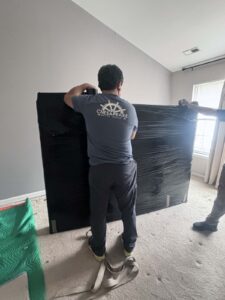
We built Chesapeake Moving Company to close that gap. When you work with us for moving and storage in Baltimore, the same team that wraps your furniture, loads the truck, and drives it to your new place is the same team that handles your storage-in-transit if you need it. One point of contact. One company accountable from your old front door to your new one, no matter how many weeks — or months — sit in between.
That continuity matters more than people expect. A crew that already knows your dining table has a wobbly leg, or that your grandmother’s china cabinet needs to stay upright, doesn’t need to relearn that information when they pull your things back out of storage. They already know.
What “Climate-Controlled” Actually Means (and Why Baltimore Summers Make It Non-Negotiable)
If you’ve lived in Baltimore for more than one July, you already know what humidity does to this city. It’s the kind of heat that doesn’t just sit on your skin — it gets into everything. And that includes your furniture.
Wood furniture swells and warps in humidity, then cracks when it dries out too fast. Electronics and old photographs are even less forgiving — moisture is one of the fastest ways to destroy a hard drive or a box of family photos that can never be replaced. Leather couches crack. Musical instruments go out of tune and sometimes never come back. Even mattresses can develop mold if they sit in a hot, damp unit for a few weeks.
Climate-controlled storage keeps your unit at a steady temperature and humidity level year-round, regardless of what’s happening outside. It’s not a luxury upcharge — for anyone storing wood furniture, electronics, instruments, artwork, or anything with sentimental or genuine dollar value, it’s really the only responsible option in a place like Maryland, where summers swing humid and winters swing cold and dry. We offer it because we’ve seen what happens when people skip it, and it’s not pretty.
The Most Common Reason People Need Both: The Gap
Closing delays are the number one reason Baltimore-area movers and storage end up going hand in hand. Real estate closings get pushed for all kinds of reasons — financing hiccups, inspection negotiations, a seller who needs an extra week. None of that is in your control, but your moving timeline still has to work around it.
Then there’s the lease overlap problem. Maybe your old lease ends on the 30th and your new one doesn’t start until the 5th. Nobody wants to pay for a few extra days of rent just to keep furniture in an empty apartment, and most landlords won’t let you anyway.
And then there’s renovation timing — people who’ve bought a new place that needs work done before they can actually live in it. Floors need refinishing, a kitchen needs to be gutted, paint needs to dry without a couch sitting against the wall. In all of these situations, you don’t need long-term storage. You need short-term storage that bridges a specific, known gap, handled by the same people who already have your stuff.
Short-Term vs. Long-Term: They’re Not the Same Service
A lot of people assume storage is storage, but the way you should think about short-term storage-in-transit is actually pretty different from long-term storage.
Short-term storage is built around a known endpoint — you know roughly when you’ll need your things again, even if the exact date shifts by a few days. It’s about flexibility and quick access, not permanence. Long-term storage, on the other hand, is for situations like an extended overseas assignment, a long downsizing process, or someone who simply has more belongings than their current space allows and doesn’t have an end date in mind yet.
Knowing which one you actually need changes how your items should be stored and accessed, and it’s worth being upfront with your moving coordinator about your timeline so they can set things up the right way from day one.
A Secure Warehouse Is Worth Asking About
When you’re trusting a company with everything you own — furniture passed down through your family, electronics, important documents, the things that make a house feel like your house — security shouldn’t be an afterthought. Ask any moving and storage company in Baltimore about how their facility is monitored, who has access to it, and how your items are inventoried going in and out. A reputable company will have a clear answer, not a vague one.
At Chesapeake Moving Company, your belongings are inventoried, wrapped, and tracked the same careful way whether they’re going straight onto a truck or sitting in storage for three weeks first. That’s part of what “full-service” actually means to us — it’s not a tagline, it’s just how we’d want our own family’s things handled.
Who This Actually Helps Most
In our experience, a few types of moves benefit from combined moving and storage more than any others. Homebuyers caught in a closing delay, who need somewhere for their furniture to live for two or three weeks without paying for overlapping leases or mortgages. Renters whose move-out and move-in dates don’t quite line up, which happens constantly in Baltimore’s rental market. Downsizing seniors and families clearing out a parent’s home, where some items are moving to a new place immediately and others need to sit in storage while the family sorts through what to keep, sell, or donate. And businesses relocating offices, where equipment and furniture sometimes need to be staged in storage while a new space is being built out or permitted.
If any of that sounds like your situation, you’re far from alone — it’s one of the most common reasons people reach out to us in the first place.
Let’s Talk Through Your Timeline
If you’re staring down a gap between move-out and move-in and not sure what to do with everything in between, give us a call. We’ll walk through your specific dates, figure out whether short-term or long-term storage makes more sense, and put together a plan that gets your things from your old place to a secure, climate-controlled space and eventually into your new home — without you ever having to coordinate between two different companies.
Chesapeake Moving Company serves Baltimore, Annapolis, Towson, Essex, Bel Air, Gambrills, and the surrounding Maryland area. Call us at (410) 620-8919 or request a free quote to talk through your moving and storage timeline today.